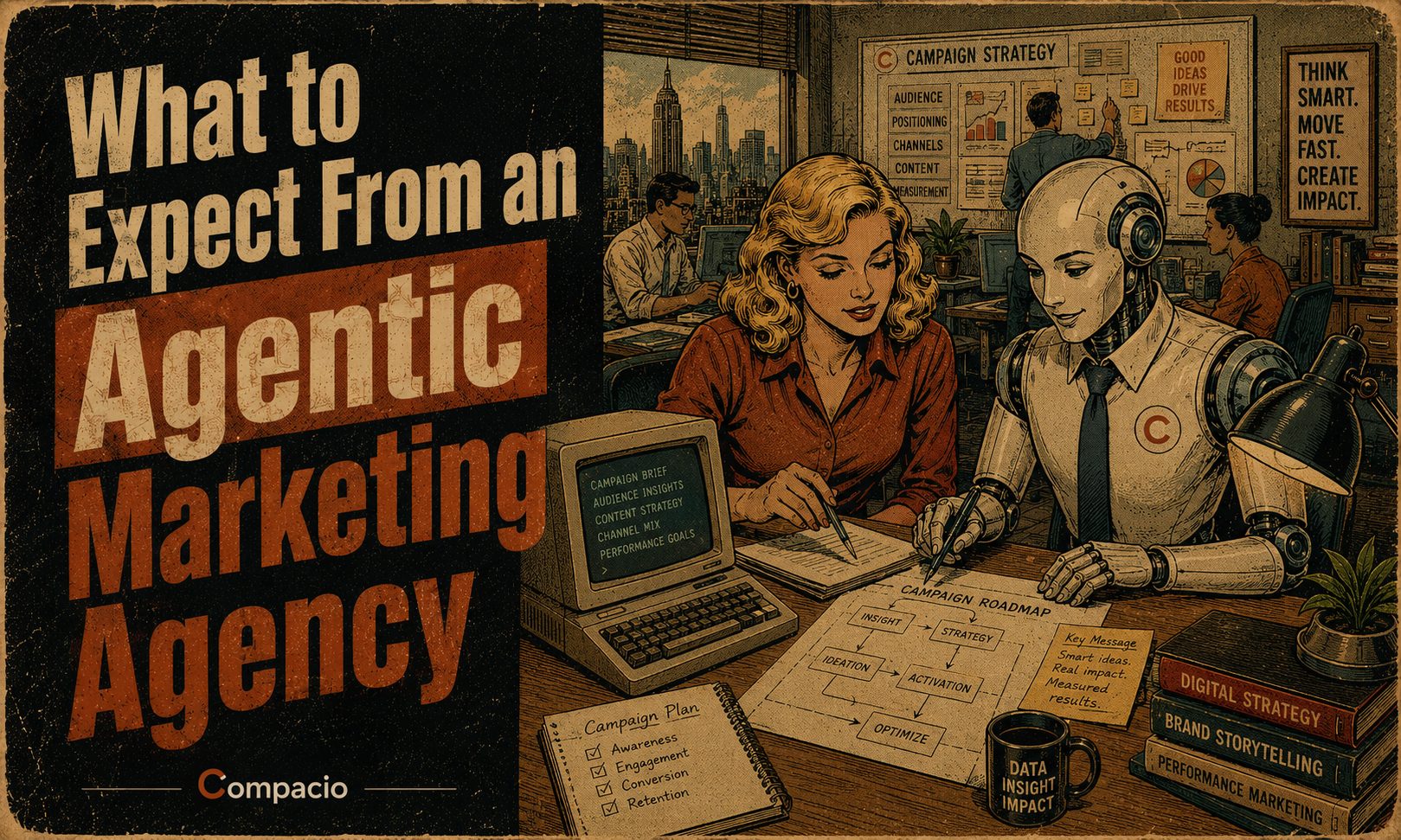
What to expect from an agentic marketing agency
An agentic marketing agency should not mean handing your brand to an unattended system.
For a service business, the practical question is more useful: can technology help your team research, create, measure, and follow up faster while people remain accountable for the message, the priorities, and the final decision?
That distinction matters. A business does not need more disconnected tools. It needs a growth system that can turn attention into qualified conversations, learning, and better decisions without losing the context that makes the business credible.
Start with the business bottleneck, not the AI tool
Most growth problems do not begin with a missing tool. They begin with an unclear commercial priority.
A service business may have a valuable offer but weak positioning. It may receive website visits but make the next step unclear. It may publish content without connecting that work to lead capture and follow-up. It may have useful customer insight trapped in sales calls, inboxes, documents, and spreadsheets.
Before automation is introduced, a credible agency should help identify the current bottleneck:
- Is the offer clear to the right audience?
- Does the website help a visitor understand the next step?
- Does content answer questions that matter before a buyer is ready to talk?
- Are enquiries followed up consistently, with enough context?
- Can the team distinguish visible activity from qualified demand?
Automation is not the diagnosis. It supports execution after a clear priority has been chosen.
What a human-reviewed growth system connects
A useful engagement brings several functions into one operating rhythm rather than treating them as separate projects.
1. Strategy and positioning
The first task is to clarify the audience, offer, proof points, service path, and commercial objective. This creates the criteria for every later decision: what to say, who to reach, which pages to improve, and which opportunities to ignore.
2. Content and SEO
Content should begin with real buyer questions, supported by search intent and first-party expertise. The result may be a new insight article, a stronger service page, a practical checklist, or a better internal-link path between education and enquiry.
SEO is not a promise of instant rankings. It is the discipline of making useful expertise understandable to both people and search systems.
3. Acquisition and lead capture
Campaigns, landing pages, forms, and calls to action need to lead somewhere specific. A visitor should not need to guess whether the right next step is a service page, a short review request, a resource download, or a conversation.
4. CRM follow-up and measurement
The system should preserve the reason a lead arrived, the question they asked, and the next responsible action. Measurement should then help the team review what is creating relevant conversations, where prospects are dropping out, and which assumptions need to be tested again.
AI can assist research, structure drafts, prepare operational checklists, surface recurring patterns, and reduce repetitive production work. Human review should remain responsible for business relevance, brand voice, sensitive claims, customer context, and final approval.
What should remain human
A responsible agency should be explicit about the boundary between assisted work and accountable judgment.
Human review should remain required for:
- Brand positioning and changes to the offer
- Customer-facing claims, case studies, and promises
- Final editorial approval of important website content
- Decisions involving CRM data, privacy, or sensitive customer information
- Publishing, deployment, outreach, and social posting
- Strategic trade-offs when evidence is incomplete
This is not a limitation. It is the governance layer that makes an AI-assisted system trustworthy.
Questions to ask before choosing a partner
Before choosing an agentic marketing agency, ask practical questions:
- Who defines the business problem before tools are selected?
- Who approves the final message and website changes?
- How will strategy connect to content, SEO, lead capture, and follow-up?
- Which measures will show progress, uncertainty, and next actions?
- Which tasks may be automated, and where does human review remain required?
- How will the team handle a recommendation that lacks enough evidence?
A credible partner should answer with a process, not broad promises about autonomy.
Earn backlinks with a resource worth referencing
Backlinks should be earned because a resource helps someone else's audience. They should not be purchased, placed through comment spam, or manufactured through fake reviews.
For this article, the most useful supporting asset is a downloadable Human-Reviewed Growth System Checklist for service businesses. It includes:
- A bottleneck diagnosis worksheet
- A map from search question to sales conversation
- A decision table for AI-assisted versus human-approved work
- Editorial, privacy, and publishing boundaries
- A simple weekly review rhythm for content, leads, and learning
That checklist creates a concrete resource for relevant business communities, CRM consultants, fractional marketing leaders, web partners, and responsible-AI resource pages to reference when it is genuinely useful.
The right approach is selective and editorial: contribute a useful insight, co-create a practical guide, or share a well-scoped first-party observation. Do not use paid link schemes, bulk guest-posting, fake identities, automated outreach, or hidden promotion.
Choose clarity over autonomous promises
No marketing system removes the need for judgment.
The right partner should help a business work with more consistency, faster learning, and clearer ownership. It should explain what is assisted, what is reviewed, what is measured, and what remains uncertain.
If you are assessing fit, request a 15-minute review through the site form. The conversation can clarify the current bottleneck, the relevant service path, and whether a human-reviewed growth system is appropriate for your business.